


As 5-MeO-DMT continues to enter mainstream conversation, more people are asking the same questions: What is it? Why is it considered so powerful? What are the real risks? And how do you know whether a facilitator or container is truly prepared to hold this work?
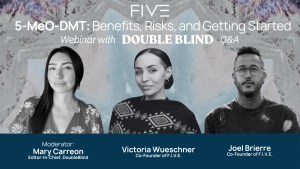
In a recent DoubleBlind webinar, 5-MeO-DMT: Benefits, Risks, and Getting Started, F.I.V.E. co-founders Joel Brierre and Victoria Wueschner joined DoubleBlind Editor-in-Chief Mary Carreón for a conversation on 5-MeO-DMT, safety, ethics, preparation, integration, and what people should understand before approaching this medicine.
*This interview has been edited for length and clarity.
DoubleBlind Q: What is 5-MeO-DMT, and how is it different from N,N-DMT?
Joel Brierre: 5-MeO-DMT is very different from N,N-DMT, which is what most people usually mean when they say “DMT.” N,N-DMT is one of the active components in ayahuasca and, when smoked in its pure form, is often described as a very visual, fractal, otherworldly experience. People may report entering different realms or encountering entities.
With 5-MeO-DMT, rather than a journey somewhere strange, the experience is often a dissolution of the subject self. The sense of “I” or ego can temporarily fall away, allowing awareness to move beyond the confines of the individual structure.
That is part of why it has been nicknamed the “God molecule.”
Many people describe it as merging with, or remembering themselves as, something infinite or boundless. It is very short-lasting, often 10 to 30 minutes with one dose, but it can be the most powerful psychedelic experience someone ever has. It can be blissful beyond imagination, viscerally challenging and terrifying, or both at the same time.
Q: Why is 5-MeO-DMT considered such a powerful catalyst for transformation?
Victoria Wueschner: There are a few reasons. One is the mystical experience itself. This is something that cannot really be understood intellectually. It has to be felt directly. For some people, that experience can fundamentally change how they understand themselves, the world, their values, their beliefs, and what is possible in their lives.
The other piece is catharsis. In many 5-MeO-DMT experiences, there can be a very strong somatic release. As the default mode network quiets, it can look like the go or self-structure is letting go of its grasp on stories, trauma, and patterns. From the outside, facilitators may see shaking, crying, laughing, yelling, purging, or other forms of release.
Joel Brierre: In a well-informed container, 5-MeO-DMT can be used as a tool to temporarily interrupt the self-structure and create a more malleable state in the brain. That is where deeply ingrained patterns may have the opportunity to shift. But the important part is the container. The potential benefits are deeply connected to preparation, safety, skilled facilitation, and integration.
Q: Is a blissful “God experience” guaranteed?
Victoria Wueschner: No, and this is one of the most important things for people to understand. A lot of people come to 5-MeO-DMT with very big expectations. They have heard it is the strongest psychedelic in the world. They have heard it can create a God experience. They may be hoping it will fix their depression, anxiety, trauma, or whatever they are struggling with.
Of course, a blissful experience can happen. But we have to stop chasing that. A challenging experience is also possible, and it is not something we are trying to run away with, stop, or mitigate. In the right container, it can be welcomed and reframed.
Sometimes what feels terrifying or grueling is the direct confrontation with something a person has been running away from for a long time. It could be unconscious material, shadow parts, trauma, or something the psyche has been protecting. That can be a huge opportunity for growth, but only if the person is properly supported.
Joel Brierre: The challenging experience is not something to avoid by default, but it has to be held in a container that is built to hold it. To crack someone open with this medicine and then leave them alone to navigate ontological shock, trauma surfacing, or deep destabilization can be very unethical.
As a participant, it is not your job to “do it right.” It is not your job to force surrender. It is your job to experience and feel what is coming up. It is the facilitator’s job to create a space where that can happen safely.
Q: What are the real physical and psychological risks people should understand?
Joel Brierre: Physically, we want to see a strong, healthy heart. If there is any question, we want a participant to see a cardiologist and get a stress-test EKG. We are looking for no major risk of stroke, aneurysm, or heart attack. A recent heart attack or stroke can be a serious concern.
There are also psychological and neurological contraindications. Schizophrenia, including schizophrenia in the immediate family, can be a contraindication. Certain central nervous system disorders require careful consideration. Medications and supplement stacks can also contraindicate in different ways, which is why a facilitator needs a strong understanding of pharmacology.
Psychologically, we are looking for a foundational sense of safety and stability in someone’s life. If someone is in active crisis, unstable housing, an unsafe relationship, or survival mode, this may not be the right time. We are also cautious around certain personality structures, bipolar I or II, mania, and other complex psychological presentations. Those are not always automatic no’s, but they do require much deeper assessment and support.
Victoria Wueschner: It is also important to know that the experience can be very physically dynamic. People can move intensely, purge, or need skilled physical support. There are also reactivations, which are re-experiences of the 5-MeO-DMT state after the session. They can be small or intense, and they can happen days, weeks, or even longer after. People need to know about that before they consent to the experience.
Q: If someone is approaching 5-MeO-DMT for the first time, what should they be vetting for?
Victoria Wueschner: First, look deeply at the team. How experienced are the facilitators with this medicine specifically? How many full-dose experiences have they sat with themselves? How many people have they supported through this medicine? Have they worked across the full spectrum of low, medium, and full-release experiences?
This all matters because low-dose 5-MeO-DMT does not always guarantee a low-dose experience. A facilitator needs to understand the full complexity of the medicine.
You also want to know who is on the team. Do they have a pharmacologist? Do they have mental health support? Are there integration specialists who actually understand 5-MeO-DMT? Are facilitators CPR and AED certified? What is the emergency protocol? Is there a doctor nearby or on site? What happens if something goes wrong?
The screening process matters, too. A quick phone call is not enough. There should be a thorough intake that looks at trauma history, medications, psychological history, medical history, and the person’s current life circumstances.
A major red flag is someone trying to sell you on the experience or telling you that you “have to” do it. Another red flag is any facilitator promising a specific outcome, like a beautiful mystical experience. This medicine is not for everyone, and a good facilitator should be participant-forward, not ego-forward.
Q: Why is integration so different with 5-MeO-DMT?
Victoria Wueschner: With other psychedelics, people often come back with a story. They may remember visions, symbols, ancestors, colors, or a journey they can talk through with an integration specialist.
With 5-MeO-DMT, the deeper someone goes, the less subjective self there may be to witness what is happening. Sometimes people come back with very little cognitive memory of the experience. That can be confusing because we are used to processing things through the mind.
But 5-MeO-DMT is often a feeling-based and somatic experience. The content may not come back as a story. It may come back through the body.
That is why somatic integration can be so important. We want to bring people back into the body and help them be aware of what is happening now. I often use the analogy of a volcano. The experience itself may be the eruption, but the lava can keep flowing for days or weeks after. Integration helps people work with what is still moving.
For us, integration is non-negotiable. If nothing is done with the content that comes up, the best-case scenario is that someone does not get much from the experience. The worst-case scenario is destabilization.
Q: What are the biggest safety and ethics concerns around 5-MeO-DMT right now?
Joel Brierre: Vape pens are one of the big ones. In the hands of a trained and experienced facilitator, a 5-MeO-DMT vape pen can be a valuable tool. But when pens are being sold without training, dosage clarity, screening, or support, they become dangerous.
We are in a different era now. Many people coming to psychedelics are coming for mental health reasons, not after decades of experience navigating altered states. Someone may be sold a pen with the promise that they can “meet God” safely in their living room. But a person can unexpectedly go into a full-release experience, experience ontological shock, asphyxiate, or be left with reactivations and no support.
Another issue is 5-MeO-DMT being offered after ibogaine as if it is an add-on or “neural reset.” This combination was originally explored by experienced practitioners in specific addiction-interruption contexts, but it has now been picked up by centers that may not understand 5-MeO-DMT. We have heard from people who were deeply destabilized after doing both in the same retreat.
The question should always be: is combining these medicines truly necessary, or are we relying on the profundity of the experience to replace the skills that therapists, facilitators, and integration specialists should have?
And then there is the toad. F.I.V.E. and Tandava are 100% synthetic. We promote synthetic 5-MeO-DMT over toad-derived secretion for three reasons: safety, dosage, and ethics. The additional alkaloids in toad secretion do not change the experience in a meaningful way, but they can add cardiac risk. Dosage is also far less precise. And ethically, we do not see a reason to harm or stress an already vulnerable species when the synthetic molecule is available.
Q: What is the main message you hope people take from this conversation?
Victoria Wueschner: 5-MeO-DMT is not something to approach casually. It can be beautiful, powerful, and transformative, but it asks for education, preparation, screening, safety, and integration.
Joel Brierre: This medicine deserves respect. The people coming to it deserve to be protected. If we want 5-MeO-DMT to have a responsible future, then safety cannot be an afterthought. It has to be the foundation.