
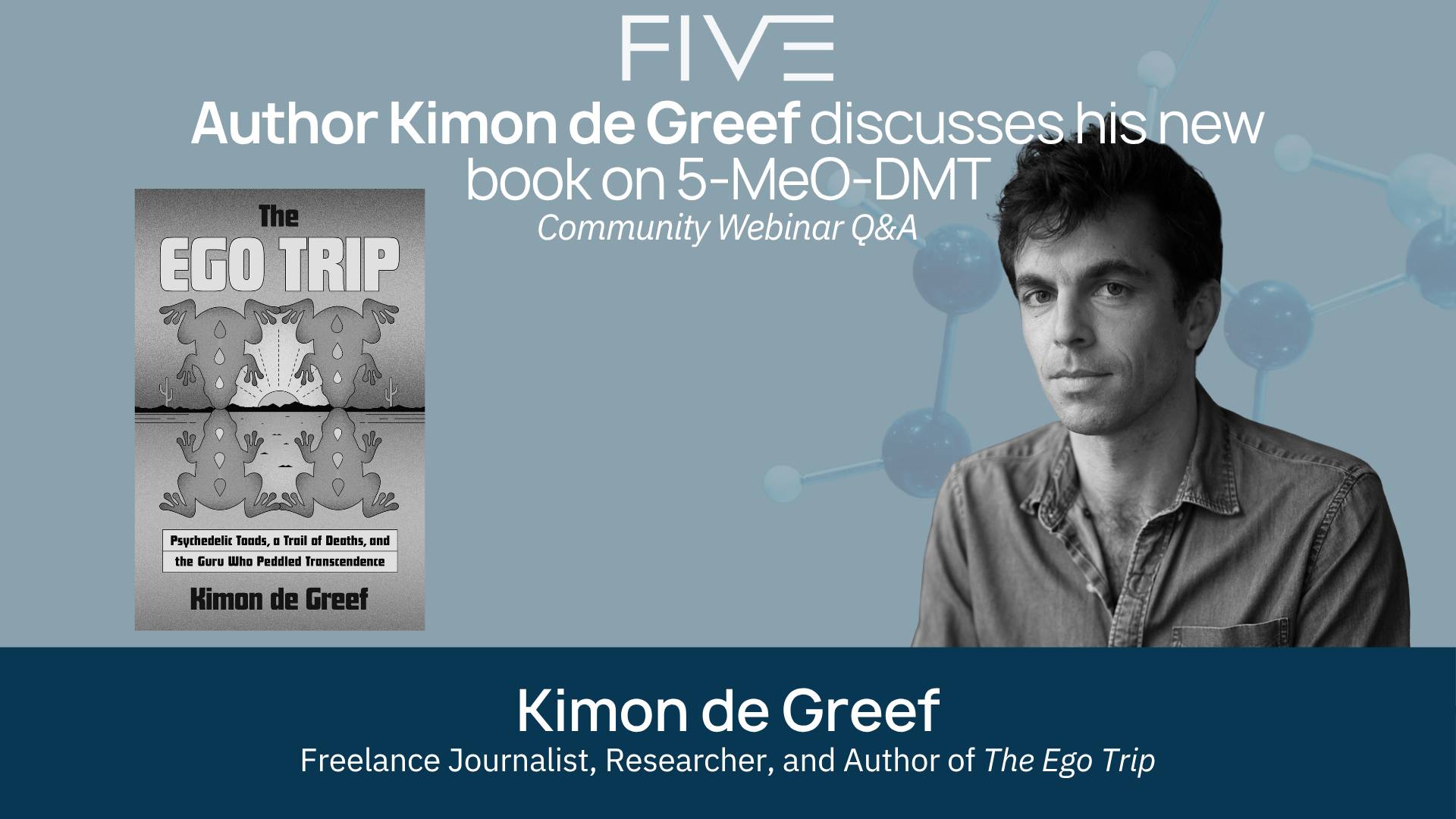
In F.I.V.E.’s recent webinar, journalist and author Kimon de Greef joined us for a conversation about his new book, The Ego Trip, and the years of reporting that took him deep into the complicated world surrounding 5-MeO-DMT.
What began as an investigation into the poaching of Sonoran Desert toads eventually became a much larger story – one involving psychedelic tourism, contested Indigenous origin narratives, charismatic authority figures, ecological and human consequences, reports of harm, and an accelerating race to transform 5-MeO=DMT into a pharmaceutical treatment.
Rather than reducing this history to a simple story of healing or harm, Kimon’s reporting examines what happens when profound psychedelic experiences encounter the much messier realities of power, commerce, belief, human vulnerability, and the systems in which experiences take place.
Read The Ego Trip
Kimon de Greef’s The Ego Trip: Psychedelic Toads, a Trail of Deaths, and the Guru Who Peddled Transcendence is available now in hardcover, ebook, and audiobook.
Learn more and purchase The Ego Trip here.
Further Reading: Fabricated Ancestrality
During the webinar, Kimon also references research by Anny Ortiz, PhD examining the historical claims surrounding ancestral use of Sonoran Desert toad secretions. He notes that the research was published after he had completed the relevant sections of his book and that it independently arrived at many of the same questions he encountered during his reporting.
In Fabricated Ancestrality: The Sonoran Desert Toad, Psychedelic Globalization, and the Ecological Politics of 5-MeO-DMT, Ortiz and colleagues examine how narratives of ancestral Indigenous use became intertwined with the modern globalization of toad-derived 5-MeO-DMT, alongside the ecological and cultural consequences of those narratives.
Read Fabricated Ancestrality in the journal Psychedelics.
*This interview has been edited for length and clarity.
Q: You originally thought you were reporting a relatively small story about toad poaching. How did that become The Ego Trip?
Kimon de Greef: I fell into the book completely unexpectedly. I have a background in conservation, and around 2020 I became interested in what I was hearing described as psychedelic toad poaching. I initially thought I might report a strange conservation story that would run at maybe 2,000 words.
There wasn’t one moment when I suddenly knew it would become a book. The story just kept getting more interesting.
Quite quickly, I encountered Dr. Octavio Rettig, who had become an extremely controversial figure in the 5-MeO-DMT community. What fascinated me was that only a few years earlier he and a handful of other very charismatic facilitators had played an enormous role in taking this very fringe phenomenon and helping turn it into a global movement.
As a journalist, there was so much there: this extraordinary animal, a complicated supply chain, a community spread across the world, and a central figure who had played such a significant role in building that community while also becoming the subject of serious allegations and criticism.
I’m not an authority on 5-MeO-DMT. I came into this world as a visitor and a reporter. But six years and hundreds of conversations later, the story had pulled me much deeper than I ever expected.
Q: What first made you question some of the stories surrounding the modern rise of “toad medicine”?
Kimon de Greef: From the outside, some of the warning signs were fairly apparent.
Early in my reporting, I encountered an open letter containing extremely serious allegations against two prominent facilitators in the space. Both men denied those allegations, but it was an unusual thing to encounter so early when trying to understand how this community had developed.
I was also skeptical of the origin story I was hearing around contemporary toad use. It was an incredibly captivating story: addiction, healing, bringing this obscure psychedelic substance into an Indigenous community, and then supposedly rediscovering a lost ancestral sacrament.
It almost sounded too perfect, and as a journalist I thought it deserved a skeptical look.
What made the story even more compelling was the contradiction between these narratives of spiritual healing and what I was beginning to learn about how the substance was actually being obtained. Here was a molecule that people described as giving them deeply transformative, transcendent experiences and connecting them to themselves, other people, and nature, but behind it was a supply chain that could be incredibly exploitative.
That disconnect became one of the central questions of my reporting: What is happening behind the story people have been told?
Q: What did your reporting in Sonora reveal about the ecological and human consequences of the toad secretion trade?
Kimon de Greef: It is difficult to definitively measure the ecological impact because the places where much of this collection happens are extraordinarily dangerous. You are talking about parts of Sonora affected by cartel violence, trafficking, smuggling, and extreme poverty. That makes something as basic as surveying toad populations extremely difficult.
So I spent time with people involved in the collection and supply chain instead.
What I saw was a commercial system in which local people, often some of the poorest and most marginalized workers in the region, could be paid to go out at night, collect toads, put them into bags or buckets, and hand them over to larger collectors. That can mean large numbers of animals being held together, transported, repeatedly handled, and milked for their secretions.
That reality is very different from the story many consumers have been told – that the substance they are receiving has come through some careful, sacred relationship with an Indigenous elder or traditional practitioner.
Even if we cannot conclusively demonstrate exactly how much collection is affecting population numbers, amphibians are already extraordinarily vulnerable to habitat transformation, pollution, and climate change. They do not need another source of pressure.
For people who care about these issues, I strongly encourage considering synthetic 5-MeO-DMT. You can engage with the molecule without participating in this entire ecological and human supply chain.
More broadly, I think there is something very human and tragic here.
Even a potentially beautiful, transcendent psychedelic experience does not permanently transcend the world. It is still connected to politics, power, economics, psychology, and everything else happening around it. Part of the role of reporting is to bring those connections back into view so people can have a more informed conversation about their own practices and intentions.
Q: Your book examines ego and charismatic authority within the 5-MeO-DMT community. What did you notice during your reporting?
Kimon de Greef: Researcher Alan Davis gave me one of the most useful ways of thinking about this. I’m paraphrasing, but if someone has an experience in which they become one with the universe, God, or however they interpret that ineffable 5-MeO-DMT state, the ego eventually reasserts itself afterward. And the ego can attach itself to that experience.
That seems like a fairly recognizable piece of human psychology.
We all have parts of ourselves we would rather identify with than others. If you introduce an extraordinarily powerful experience that can make someone feel as though they have encountered some ultimate truth, I can imagine how that could amplify those dynamics.
And during my reporting, I encountered some very big egos.
Spending time with Octavio was fascinating because he could be incredibly charming and charismatic while also appearing remarkably blind to his own faults or to criticism.
There is another feedback loop for facilitators as well. People are having some of the most profound experiences of their lives and then directing enormous gratitude, admiration, or authority toward the person who facilitated the experience. I became very interested in what happens when someone starts identifying with that projection.
The combination of a charismatic or messianic figure with an incredibly powerful psychedelic molecule can heighten dynamics that already exist in spiritual communities.
Q: What safety, consent, and accountability concerns stood out most to you while reporting the book?
Kimon de Greef: One of the most astonishing things for me was how casual some environments could be around extremely vulnerable psychedelic states.
I observed group sessions where people could be having extraordinarily deep experiences while strangers or people they barely knew were watching or filming. The culture around cameras particularly surprised me. It sometimes felt as though filming was the default and a participant had to actively opt out.
I also witnessed 5-MeO-DMT being administered in settings that seemed very far from medical assistance, people being left unattended while physically moving or thrashing, and other practices that struck me as unnecessarily risky.
But another issue that became important to me was how communities respond when someone says they have been harmed.
I saw versions of this argument repeatedly: everyone else was fine, so what was wrong with you? Maybe you did not surrender enough. Maybe you were afraid. Maybe something about you caused the outcome.
I think that can become a very sinister form of community gaslighting.
A community that does not listen to the voices of people who have been hurt becomes a dangerous community. We recognize that dynamic when talking about sexual assault, abuse, and other forms of harm. I do not think it should suddenly be treated differently because the experience involves a substance someone considers sacred or calls the “God molecule.”
Q: Today, 5-MeO-DMT is moving from underground use into pharmaceutical development. Does that solve some of these problems or introduce new ones?
Kimon de Greef: I’m fascinated by the effort to turn 5-MeO-DMT into a licensed medication for mental health conditions.
There is promising early research, and formal medical approval could potentially solve a number of problems associated with underground use. You can establish dosing standards, better understand contraindications, and gather proper safety data across much larger groups of patients.
But it introduces an entirely different set of concerns.
You now have commercialization of the psychedelic experience, intellectual property battles around this molecule, and efforts to minimize the therapeutic component of treatment for various strategic and economic reasons.
One of the questions I keep thinking about is what happens after the experience. You are potentially giving someone an extraordinarily transformative psychedelic experience in a clinical mental health setting, collecting safety data for a certain period, and then sending that person home to process something that could continue affecting them for weeks or months.
So I don’t see the pharmaceutical story as simply good or bad.
Medicalization may address real problems in the underground while resting another set of questions around commercialization, care, support, and what responsible treatment actually looks like.
That is part of what has been so remarkable about reporting this story. In a relatively short period of time, 5-MeO-DMT has moved from a fringe underground practice, through the rise and controversy of the modern toad movement, and into a pharmaceutical race involving some of the largest companies in medicine.
And that story is still unfolding.