
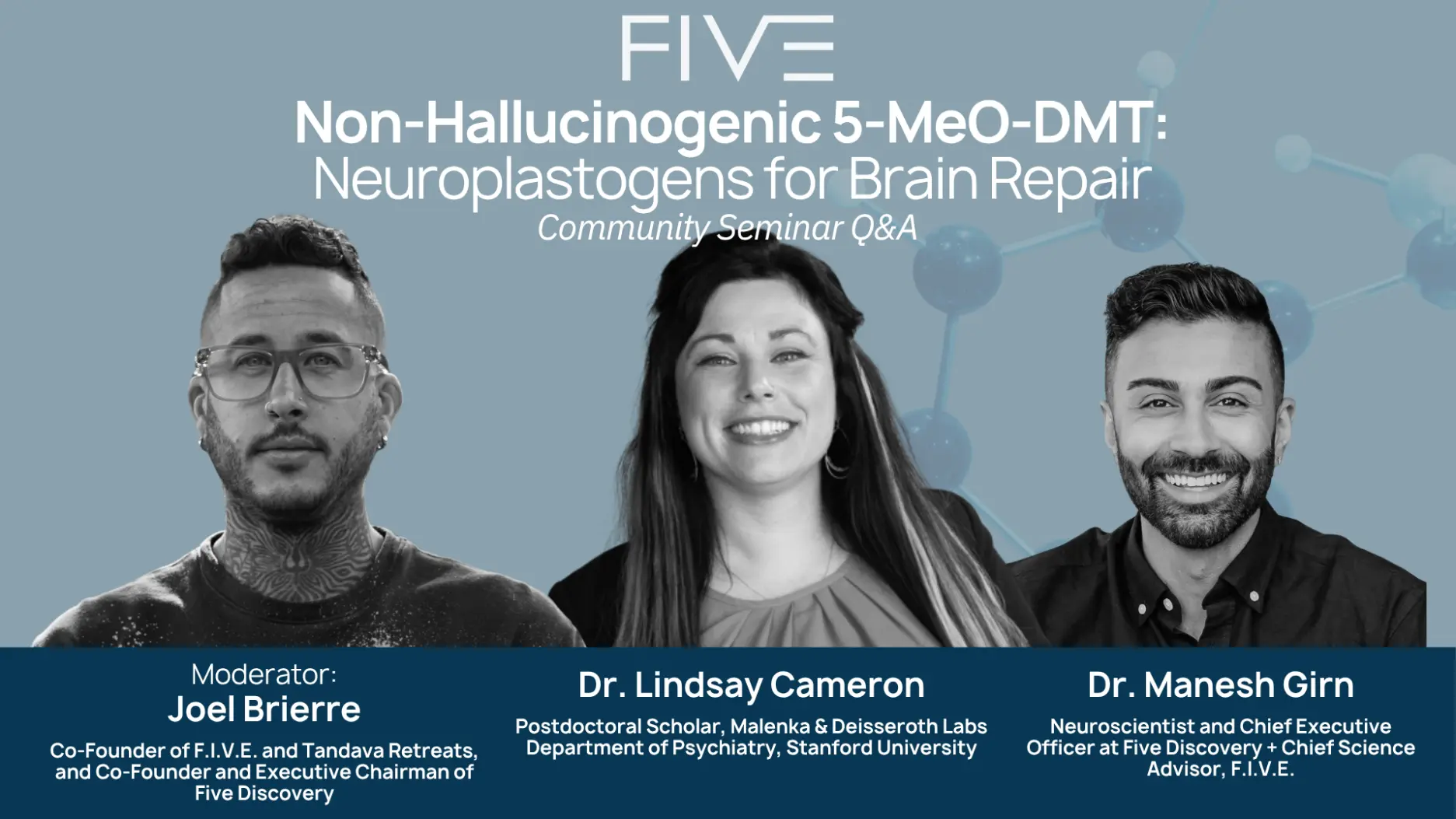
In The F.I.V.E. Institute’s recent seminar, neuroscientists Manesh Girn, PhD and Lindsay Cameron, PhD joined The F.I.V.E. Institute Co-Founder Joel Brierre for a conversation about an emerging area of psychedelic science: non-hallucinogenic neuroplastogens.
The discussion centered on a simple question: Can some of the biological effects associated with psychedelics be separated from the psychedelic experience itself?
From the mechanisms driving neuroplasticity to the possibilities for Parkinson’s disease, Alzheimer’s disease, and other neurological conditions, Girn and Cameron explored where the science is showing promise, why non-hallucinogenic compounds may expand access to psychedelic-inspired medicines, and just how much researchers still have to learn.
*This interview has been edited for length and clarity.
Q: To start with the basics, what exactly is a neuroplastogen?
Lindsay Cameron: Neuroplastogens are small molecules that can promote neuroplasticity. Neuroplasticity broadly means changes in the brain – strengthening connections, weakening connections, forming new ones – and those changes can be either helpful or harmful depending on the context.
With psychedelics, one of the things we tend to see is an increase in synapses in the prefrontal cortex, an area of the brain that is important for regulating mood and motivated behavior.
Manesh Girn: One useful way to think about neuroplastogens is that they enhance the brain’s natural ability to change.
Psychedelics can produce these profound psychological experiences – mystical experiences, emotional processing, insights, feelings of connectedness – but underneath that, there are also neuroplastic and anti-inflammatory effects taking place.
That raises an important question: how much of the lasting benefit is coming from the psychological experience, and how much is coming from the neuroplasticity itself?
Neuroplastogens may temporarily create a window in which the brain is more amenable to change. They may also help support or repair circuits that have been affected by things like chronic stress, aging, or brain injury.
Q: Do you actually need the psychedelic experience in order to receive therapeutic benefits?
Lindsay Cameron: That question is really what started this work for me. When I began this research, there were studies showing a relationship between mystical experiences with psilocybin and improvements in things like depression. What I wanted to know was: do you actually need that experience in order to feel better? Or could the drug produce beneficial effects independently of the hallucinations?
Accessibility was also a major part of that question. Psychedelic therapy can require a lot of time and resources, and there are also people who may not want to have a psychedelic experience or who may be excluded from these treatments.
So during my PhD, we synthesized a library of compounds and systematically changed their structures. We looked at which compounds appeared hallucinogenic and which did not, and then tested whether they could still promote neuronal growth, create new connections, and produce anti-depressant-like effects.
We found that it was possible to create compounds that appeared non-hallucinogenic while retaining therapeutic properties. That was incredibly exciting.
Manesh Girn: I was actually very skeptical when I first heard about this. My entry into psychedelics came partly through personal experience and meditation, so initially my reaction was: psychedelics without the trip? That seems like removing the whole point.
But my perspective changed. I don’t see non-hallucinogenic neuroplastogens as replacements for psychedelics. I see them as a complement.
There may be people who could benefit from the biological effects of these compounds but don’t want, can’t tolerate, or shouldn’t necessarily undergo an intense psychedelic experience. Older adults are one obvious example.
If we can create another useful tool that is more accessible to those populations, I think that’s worth exploring.
Q: How can a compound promote neuroplasticity without producing a psychedelic experience?
Lindsay Cameron: The serotonin 2A receptor appears to be very important. It is highly expressed in the prefrontal cortex, and psychedelics engaging that receptor can activate pathways associated with neuronal growth and plasticity.
There is still debate around exactly what separates a hallucinogenic compound from a non-hallucinogenic one, but one of the important findings from this research is that activating pathways involved in plasticity does not necessarily mean you have to produce the same subjective psychedelic effects.
Manesh Girn: There are different levels at which you can look at this. At the level of individual neurons, neuroplasticity can involve neurons growing more dendrites – those branch-like structures that give other neurons more opportunities to connect with them.
At the whole-brain level, psychedelics also change the way large-scale brain networks communicate. We see things like increased communication between networks and disruption of established network organization.
One possibility is that those acute brain-network changes are more closely related to increased neuronal activity and the psychedelic experience, while neuroplasticity contributes more to longer-term changes that unfold over the following days, weeks, or months.
We are still trying to fully understand that distinction. One thing I’d love to see is brain-imaging research on non-hallucinogenic psychedelic analogs. That could help us understand what is happening at the network level when you produce plasticity without the psychedelic experience.
Q: Why is Five Discovery looking at non-hallucinogenic compounds for neurological and neurodegenerative conditions rather than only mental health disorders?
Manesh Girn: That was one of the things that really motivated Five Discovery. Through conversations with Joel and others around Tandava Retreats, I kept hearing anecdotal reports from people who had come in for spiritual or mental health reasons but described unexpected neurological improvements – things like reduced brain fog or improvements in memory, particularly among people with histories of concussion.
Those reports obviously aren’t clinical evidence, but they raised an interesting scientific question for me: could there be something worth investigating in neurological disease?
At the same time, Lindsay had already done foundational work on non-hallucinogenic analogs.
That brought the pieces together. Could we develop compounds inspired by psychedelics that aren’t intended primarily to treat depression or anxiety, but instead potentially support damaged brain circuits or slow aspects of neurological disease? That’s the direction we’re interested in exploring.
Lindsay Cameron: And I think one of the interesting things about the approach is the combination of mechanisms we’re looking at.
There is the neuroplasticity side, but with 5-MeO-DMT there is also interesting activity at the serotonin 1A receptor, alongside serotonin 2A signaling.
That creates opportunities to design compounds around a specific neurological problem rather than simply making a non-hallucinogenic version of an existing psychedelic.
Q: Why has Parkinson’s disease – and specifically Levodopa-Induced Dyskinesia – become an important area of focus?
Manesh Girn: We originally looked very seriously at traumatic brain injury, but TBi is extremely complex. There are many different kinds of injuries, the clinical endpoints can be difficult to define, and even the animal models vary considerably.
So we started looking for a neurological condition with a clearer scientific and clinical pathway.
One piece of evidence that caught my attention came from research in people with Parkinson’s disease. A small study involving psilocybin was primarily looking at depression associated with Parkinson’s, but researchers also observed changes in Parkinson’s symptoms, including motor symptoms.
That led us toward Levodopa-induced Dyskinsea, or LID. Levodopa is commonly used to increase dopamine in people with Parkinson’s, but over time some patients develop dyskinesia – uncontrolled or involuntary movements associated with the treatment.
There is existing evidence that serotonergic mechanisms, particularly the serotonin 1A receptor, may be relevant to LID. And 5-MeO-DMT is interesting because it interacts strongly with serotonin 1A while also engaging serotonin 2A pathways associated with neuroplasticity.
So the idea became: could we develop a non-hallucinogenic compound that brings those mechanisms together?
It’s still early, but scientifically, we think that’s a very interesting direction.
Lindsay Cameron: That’s what I find particularly compelling about it. There is already research outside the psychedelic field connecting serotonin 1A signaling with Parkinson’s and LID. Then there is this separate body of work around psychedelics and neuroplasticity. What we’re trying to explore is whether those two areas can be brought together within one medicine.
Q: Could this approach eventually have relevance for conditions like Alzheimer’s disease as well?
Manesh Girn: I think there is significant potential there, although we’re still talking about an early area of research.
With Alzheimer’s disease, you see neuronal atrophy – neurons losing some of their structure and function – as well as increased inflammation.
If a compound can promote neuroplasticity while also producing anti-inflammatory effects, there’s a reasonable scientific question around whether it might help push against some of those processes.
The other important piece is dosing.
A non-hallucinogenic compound could potentially be administered repeatedly without requiring someone to undergo an intense psychedelic experience every time. That becomes particularly relevant when thinking about chronic neurodegenerative disorders, where treatment may need to be ongoing rather than a one-time intervention.
But that’s very different from saying we know these compounds treat Alzheimer’s. We don’t. The research is still developing.
Lindsay Cameron: There is also psychedelic research already beginning in populations with Alzheimer’s disease, particularly around depression associated with the condition.
What will be interesting is whether those studies reveal changes beyond mood symptoms, similar to some of the unexpected motor findings researchers have seen in Parkinson’s work.
These are active questions right now. We don’t have the answers yet.
Q: What are some of the biggest unanswered questions in non-hallucinogenic neuroplastogen research?
Lindsay Cameron: There is a lot. Even something like the anti-inflammatory effects is still an active area of research. There is encouraging preclinical work showing that serotonergic compounds can have potent anti-inflammatory effects, sometimes at relatively low doses, but designing non-hallucinogenic compounds specifically around those properties is still very new.
More broadly, we need significantly more human data. A lot of what we understand about neuroplasticity comes from cellular work and animal models. Translating that into human treatments is an entirely different challenge.
Manesh Girn: And I think the relationship between the experience and the biology is still one of the biggest questions. When studies find that the intensity of a mystical experience correlates with better outcomes, there are several possible explanations. Maybe the experience itself is therapeutically important. But a stronger psychedelic experience might also correlate with greater receptor activation, different biological effects, or greater neuroplasticity.
Those things are happening together.
To really understand what is necessary, we need experiments that can separate those mechanisms.
That’s part of what makes non-hallucinogenic neuroplastogens scientifically interesting. They give us another way to ask the question: what happens when you retain some of the biology associated with psychedelics while removing much of the psychedelic experience?
We are still very early in answering that, but that’s exactly why the field is so interesting.